New to peptides? Start here.
A peptide vial can look a little strange at first. Here’s what’s normal, and how the basics work.
It’s a powder in a small glass bottle
Most peptides come as a dry powder in a small glass bottle called a vial. The powder is freeze-dried, so it might look like a tiny white cake, a thin film, or almost nothing at all. That’s normal. The amount of powder is often very small, so a vial can look nearly empty.
Most are white, but blue is OK
Anything with GHK-Cu (also called copper peptide) is blue. The copper makes it blue. Blends that have GHK-Cu in them, like GLOW, are blue too.
Vial sizes
The mL number on a vial tells you how much liquid it can hold. You can never add more BAC water than that. Most vials come in one of two sizes.
- 3 mL: the size you’ll see most, and it’s usually mixed with about 1 to 2 mL of BAC water, well under the 3 mL it can hold
- 10 mL: holds up to 10 mL, for bigger amounts like NAD+, which usually comes as 500 mg or 1000 mg
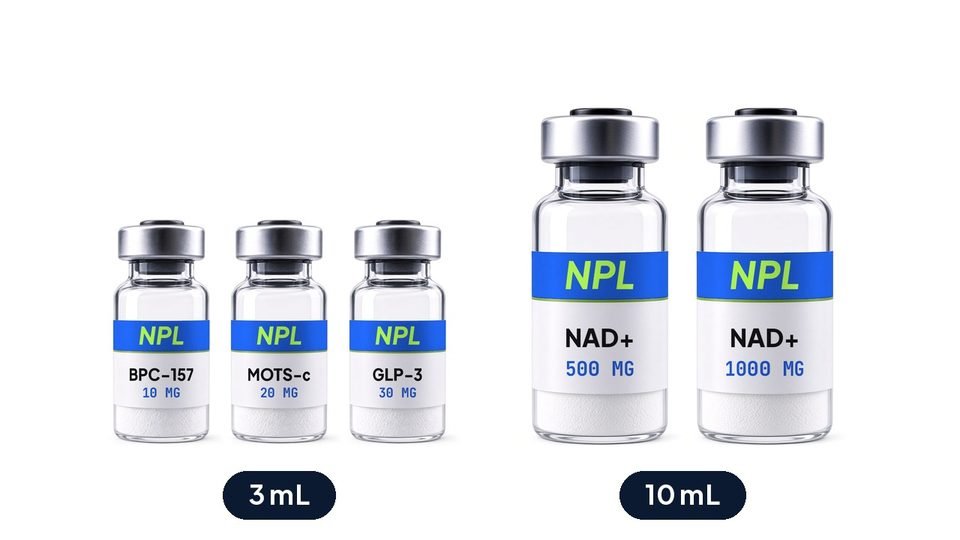
The powder can look the same in every vial, so always check the label. It shows how much peptide is inside, in mg or IU.
Where was it made?
A peptide is made in two big steps. First, the active ingredient, the peptide itself, is built. Then it’s finished: mixed, sterilized, filled into vials, and often freeze-dried. The two steps can happen in different countries.
In 2019 testimony to Congress, FDA said 28% of the facilities making drug ingredients for the US market were in the US and 13% were in China. Those are counts of facilities for all drugs, not how much each one makes. FDA said it couldn’t tell with any precision how much of the volume comes from China.
Here’s what common label words mean:
- Under a Federal Trade Commission rule, “Made in USA” by itself means “all or virtually all” of the product was made in the US, including what’s inside
- If the peptide itself was made in China and only finished in the US, it can’t carry a plain “Made in USA” label
- A label such as “Made in USA from imported ingredients” says part of it came from abroad
Customs uses a different test: where the product last became something new, with a new name, character, and use. Customs has generally ruled that turning a bulk ingredient into doses doesn’t change its origin. We found no ruling on a peptide built in the US from imported amino acids.
A certificate of analysis, or COA, is a lab report for one batch. FDA guidance for drug ingredients says a COA should name the original maker and its address, and that drug makers should check that COAs can be trusted. That’s a recommendation, not a rule, so a research-use COA may leave the maker off. Our take: a purity result covers only the batch tested and isn’t proof of where it was made.
Syringes
Most people use insulin syringes marked U-100. On these, 100 units = 1 mL. That’s why our dose calculator gives its answer in units.
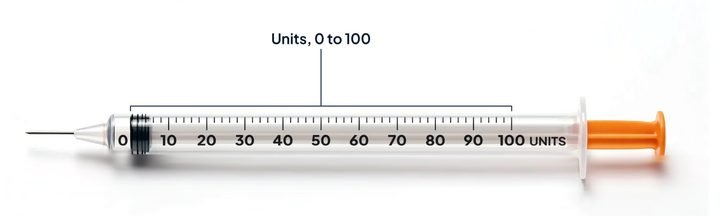
- Needle: a thin one, 29 to 31 gauge (the higher the number, the thinner the needle)
- Length: short, 5/16 inch or 1/2 inch
- Size: 0.5 mL or 1 mL (the 0.5 mL has finer lines, so small amounts are easier to read)
Keep alcohol pads on hand too.
Mix it with BAC water
The powder has to be mixed with BAC water before it’s used. BAC is short for bacteriostatic. It’s clean, sterile water with a tiny bit of benzyl alcohol (0.9%), which stops germs from growing. That’s why one vial can be used more than once. Plain sterile water doesn’t have it, so it’s not the same thing.
Our dose calculator tells you how much to add.
How to mix a vial:
- Wipe the tops of both vials with an alcohol pad
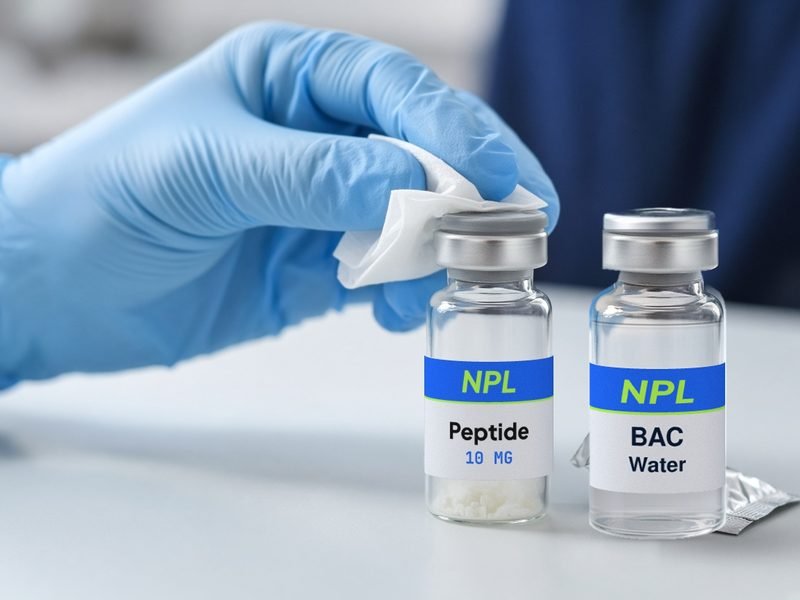
Wipe the rubber top before every use - Draw up the BAC water
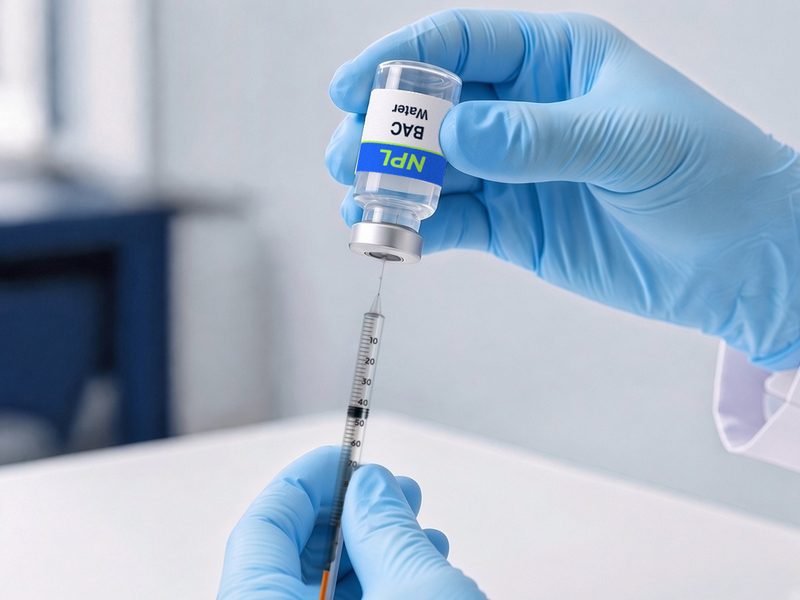
Turn the BAC water vial upside down and pull back slowly - Point the needle at the inside of the glass and push slowly, so the water doesn’t land right on the powder
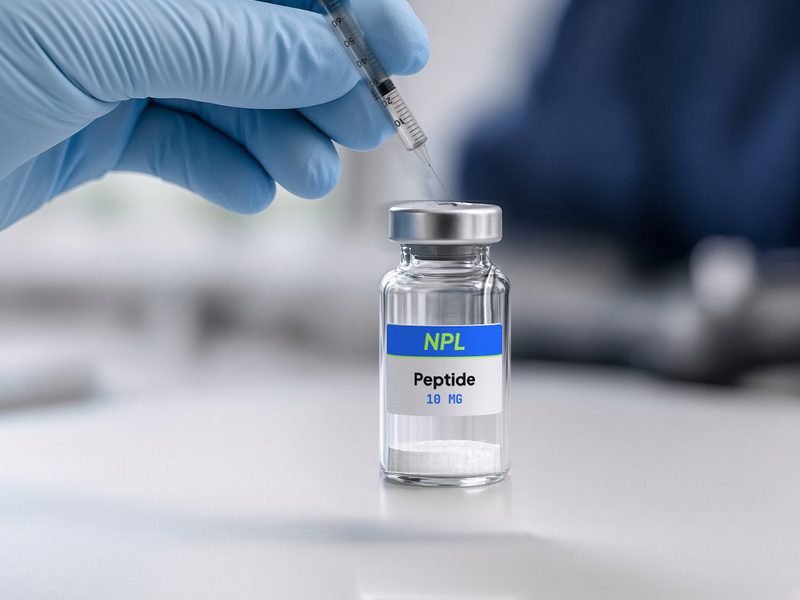
Aim for the glass, not the powder - Swirl gently until it’s clear, with no shaking
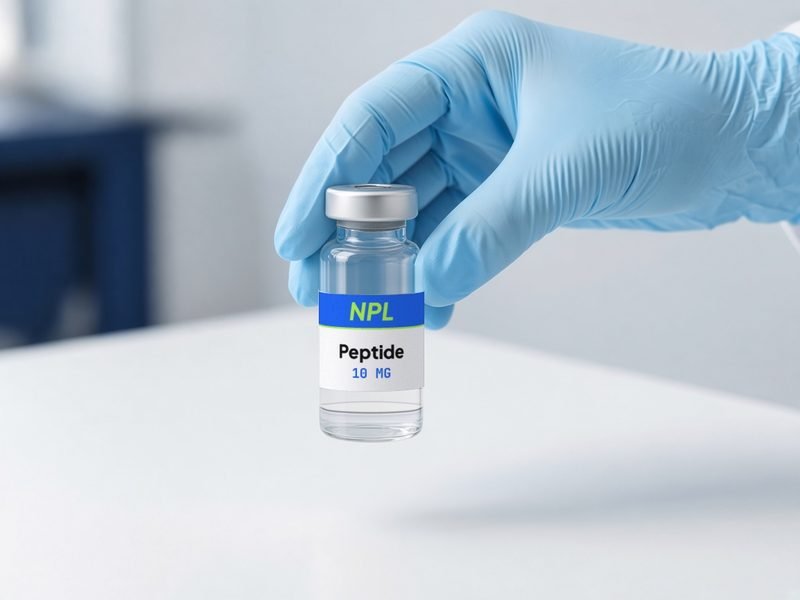
Swirl gently, never shake


Where to keep it
- Powder: the freezer is best
- Mixed vials: the fridge, out of direct light
- BAC water: never the freezer
Mixed vials and BAC water are liquids, and liquids never go in the freezer.
Where to inject
These are subQ injections, which means “under the skin.” The needle goes into the fat layer, not the muscle. Common spots:
- your belly, at least 2 inches from your belly button
- the outer thigh
- the back of the upper arm
Switch spots each time.
Why most are injected
Peptides are small proteins. Your stomach breaks down proteins, so most peptides wouldn’t survive being swallowed. That’s why most are injected.
A few work another way
A small number of peptides have been studied as nose sprays, like PT-141, Semax, and Selank. Peptides you swallow are rare and need a special formula to get past the stomach. One example is a tablet form of semaglutide, an approved drug.
Sources
The sources below support the “Where was it made?” section and the line on semaglutide tablets. Each one links to the original government rule, customs ruling, guidance, testimony, or drug label.
- Federal Trade Commission (2024). Complying with the Made in USA Standard (opens in a new tab). Federal Trade Commission.
- Federal Trade Commission (2026). 16 CFR Part 323, Made in USA Labeling (opens in a new tab). Electronic Code of Federal Regulations.
- U.S. Customs and Border Protection (2026). 19 CFR 134.1, Definitions (country of origin marking) (opens in a new tab). Electronic Code of Federal Regulations.
- U.S. Customs and Border Protection (2017). Ruling H284691: Country of origin of bimatoprost ophthalmic solution; substantial transformation (opens in a new tab). U.S. Customs and Border Protection.
- U.S. Customs and Border Protection (2015). Ruling H267177: Country of origin of acyclovir tablets; substantial transformation (opens in a new tab). U.S. Customs and Border Protection.
- U.S. Customs and Border Protection (2024). Ruling N340478: Tariff classification and country of origin of vasopressin injection USP (opens in a new tab). U.S. Customs and Border Protection.
- U.S. Food and Drug Administration (2026). 21 CFR 201.1, Drugs; name and place of business of manufacturer, packer, or distributor (opens in a new tab). Electronic Code of Federal Regulations.
- U.S. Food and Drug Administration (2016). Q7 Good Manufacturing Practice Guidance for Active Pharmaceutical Ingredients (opens in a new tab). U.S. Food and Drug Administration.
- Woodcock J (2019). Safeguarding Pharmaceutical Supply Chains in a Global Economy (opens in a new tab). U.S. Food and Drug Administration.
- U.S. Food and Drug Administration (2026). Semaglutide injection and tablets for weight management: prescribing information (opens in a new tab). Drugs@FDA.
For research use only.